As we gaze into the night sky, the universe unveils its spectacular tapestry of celestial objects. Among these cosmic wonders is the Tulip Nebula, also known as Sharpless 101 (Sh2-101), a vibrant emission nebula located in the constellation Cygnus, approximately 6,000 light-years away from Earth.
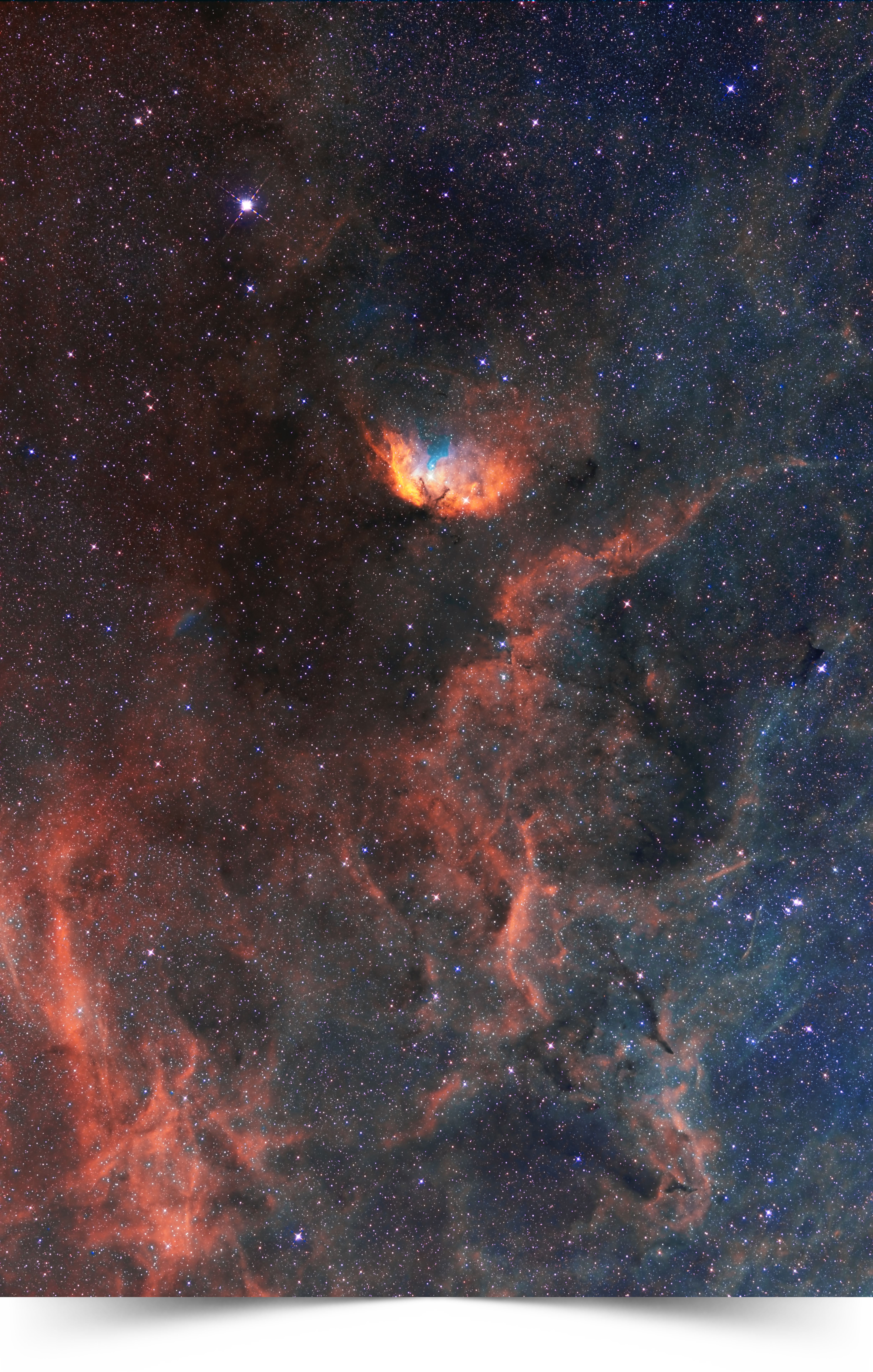
The Tulip Nebula
Named after its floral appearance, the Tulip Nebula blooms in the vast garden of the Milky Way. This interstellar cloud of gas and dust is energized by the ultraviolet light from young, hot stars within and around it, causing it to emit its characteristic glow.
Its radiant red color is primarily due to the hydrogen gas being ionized and forming an HII region, an area of active star formation. Despite its beauty, the Tulip Nebula is not readily visible to the naked eye. It requires the aid of a telescope along with astrophotography techniques to bring its details to life.
Star Formation and WR 134
The processes within the Tulip Nebula are emblematic of the life cycle of stars. Under the influence of gravity, the dense regions within the nebula collapse, creating protostars that eventually become main sequence stars like our Sun. Observing these celestial nurseries helps astronomers understand more about how stars and planetary systems are born.
Adding to the spectacle, a rare and massive Wolf-Rayet star, known as WR 134, is located near the Tulip Nebula. The fierce stellar winds and radiation from WR 134 sculpt the dust and gas of the nebula, influencing its shape and luminosity. Wolf-Rayet stars are in a late phase of stellar evolution, making their contribution to the dynamics of the surrounding nebula quite significant.
Imaging Equipment
- Photographer: You Wenhua De Baogongtou
- Camera: ToupTek ATR2600M / ATR3CMOS26000KMA
- Guide Camera: ToupTek GPCMOS02000KMA
- Telescope: Takahashi E-130D
- Equatorial Mount: CEM70

Conclusion
While the Tulip Nebula (Sharpless 101) may not be as well-known as some other astronomical features, its fascinating characteristics and the dynamic processes it embodies make it a worthy subject for both professional study and amateur appreciation. As we continue to explore the cosmos, let us never cease to marvel at the natural wonders like the Tulip Nebula that adorn our night sky.