What ADC Bit Depth Means
Analog-to-digital converter chips (ADCs) transform information from analog to digital form, facilitating processing and analysis in digital systems. This conversion is crucial for signal processing in modern electronic systems, as digital electronic devices such as computers, smartphones, and sensors can only process digital signals.
The resolution of an ADC refers to its ability to discern the smallest changes in the analog signal, often measured in bit depth. The color depth of a photo can be 8 bits, 10 bits, 12 bits, 14 bits, or 16 bits. Higher bit depths provide greater resolution and more levels of color quantization. For example, 14 bits can record 2^14, or 16,384 levels of color gradient, while 16 bits can record 2^16, or 65,536 levels.
How Astronomical Cameras Achieve 16-bit Depth
Imagine you are in a room with three adjustable lights, each with different bit depths: 12-bit, 14-bit, and 16-bit. Their brightness can vary from completely dark to very bright. When all three lamps are fine-tuned simultaneously, the 16-bit light changes smoothly in brightness, while the 12-bit lamp has a larger fluctuation in brightness.
The dynamic range in astrophotography is similar to the change of light. Higher bit depths show more subtle changes in light and provide smoother, more natural transitions between light and shadow.
ATR2600M/C Native 16-bit ADC and ATR585C HDR Mode
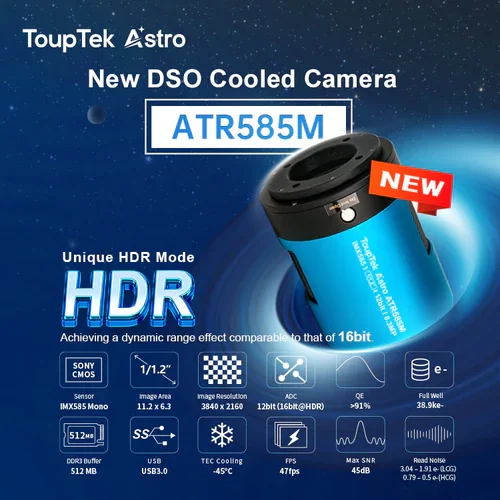
The ATR2600M and ATR2600C are equipped with a native 16-bit ADC, providing performance in both brightness and darkness. The ATR585C, equipped with a native 12-bit ADC, can achieve brightness changes similar to 16-bit when HDR mode is enabled. In HDR mode, the sensor captures two images simultaneously, one with low gain and one with high gain, and then merges them directly into a single image.
In short, this mode allows the best of both worlds: low-gain full well and high-gain, low-read noise. It allows the simultaneous capture of very dark and very bright targets, preserving more details in both light and dark areas. This avoids issues like loss of layering of the target celestial body and the difficulty of choosing between highlights and shadows.
Whether in the highlight area of the target sky or in the surrounding dark cloud area, the ATR2600M/C and the ATR585C in HDR mode can achieve strong contrast between light and shade, enabling more precise post-processing without the risk of color banding in the image.
Quantum Efficiency and Pixel Size
In addition to optimization in HDR mode, the ATR585C's quantum efficiency also has been further improved. Despite its 2.9 um pixels being slightly smaller than the ATR2600C's 3.75 um pixels, its shooting efficiency remains comparable to that of the ATR2600C.
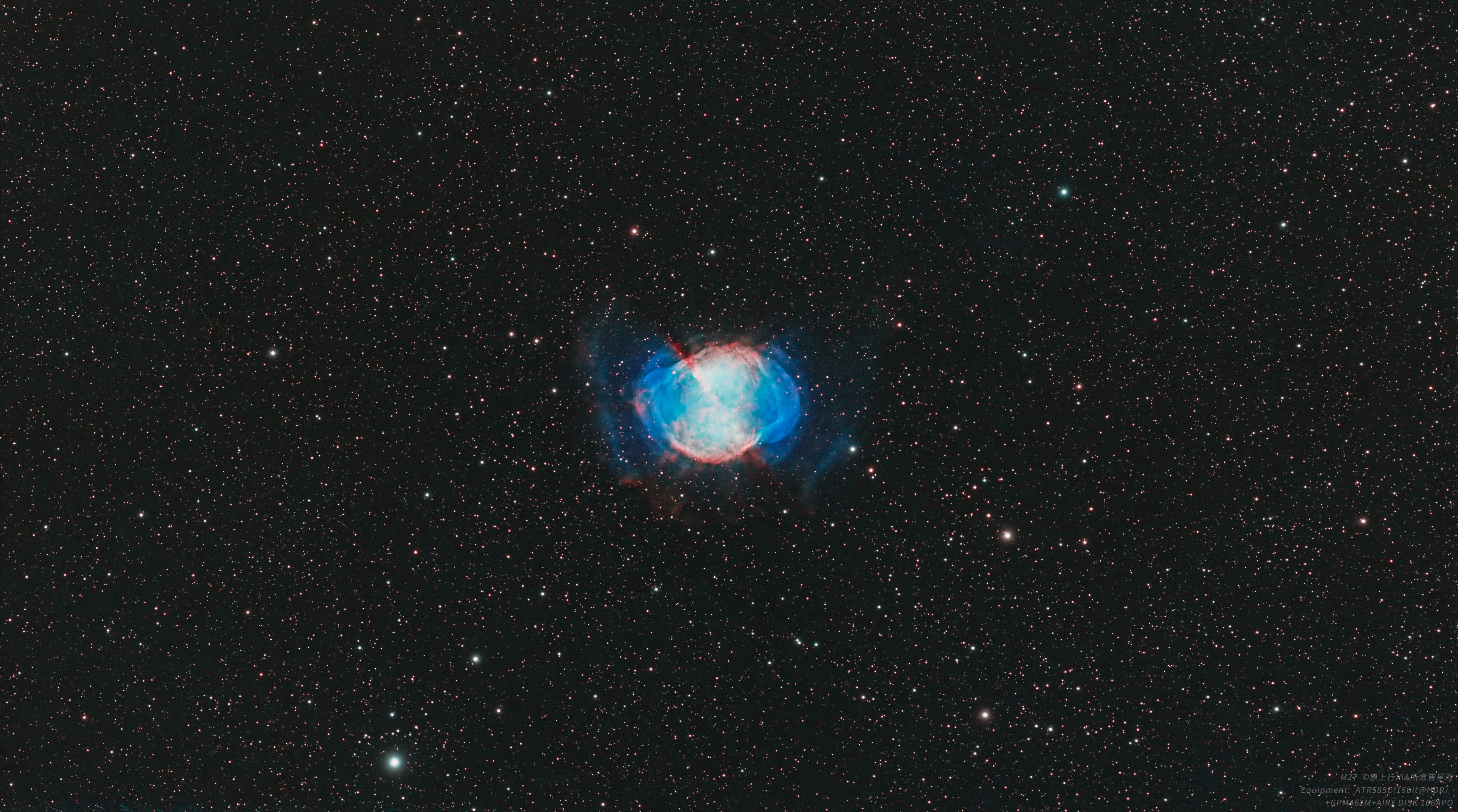
Related equipment shown in this article includes the ATR585C and GPM462M.